Mesa dos 28
Who reviews what the AI wrote? Lenses based on the public work of 28 experts read the project and cite file and line; the code checks every citation, and the final decision is human.
- Role
- Author, personal project
- Period
- 2026
- Status
- in progress
- LLMs and agents
- Python
- Claude Code
- Codex
- Antigravity
- pytest
- mypy
- ruff
Plain explanation
The problem
People who work and study all day have no time for an AI course. And what the leading names in the field teach is scattered across videos, posts and courses, and it changes every week.
At the same time, building with AI is fast, but the result arrives without a trail: unexplained decisions, tests that never ran and "facts" nobody checked. Reviewing everything alone does not work, and calling in every expert for every question is expensive.
What it does
- Follows those who teach
Every Friday, AI assistants look up what each reference published that week, in that person's own sources, and update the 28 guides based on their work.
- Calls only those who know the topic
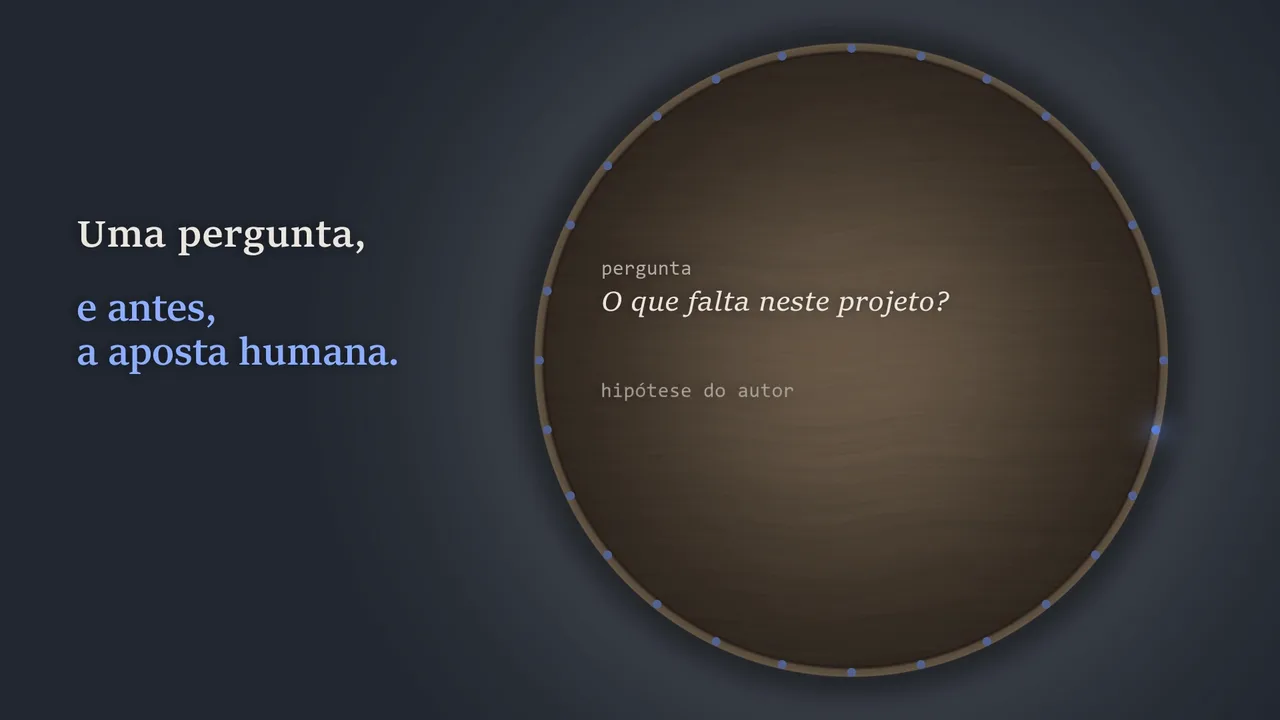
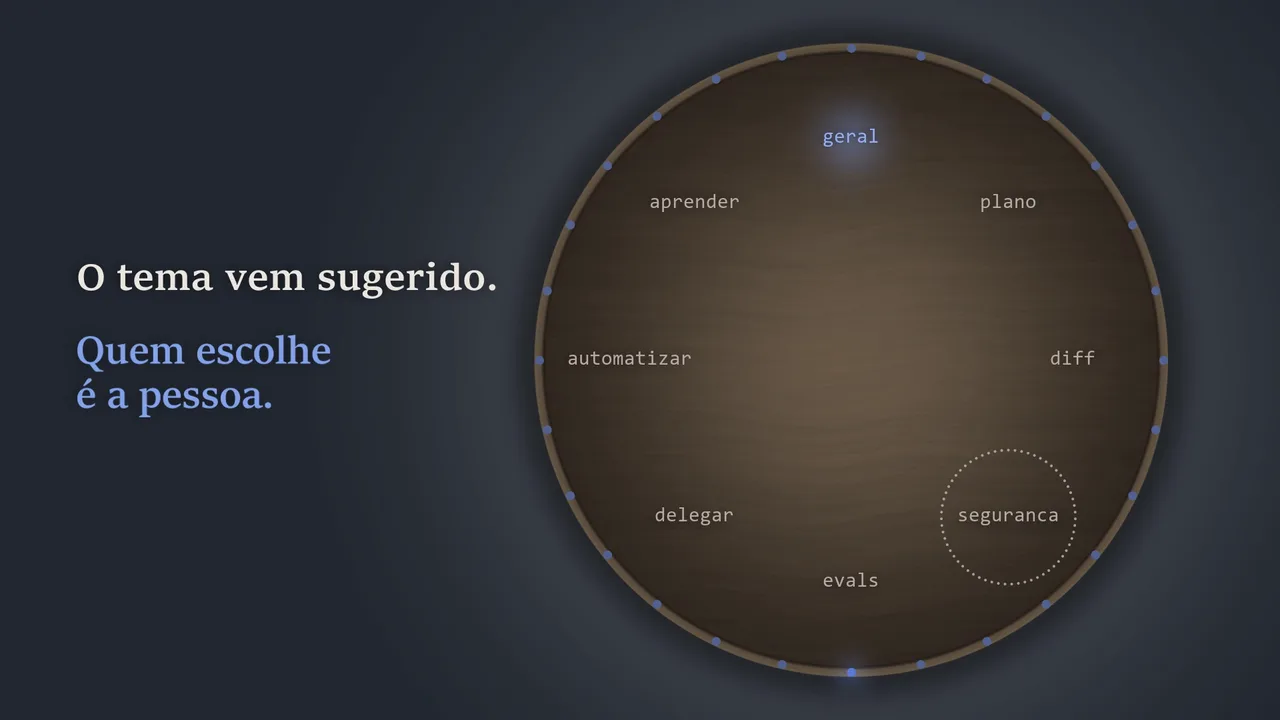
You write the question and, before it, what you bet you will hear. The table calls 3 to 5 guides who know that subject, not all 28.
- Points to the file and the line
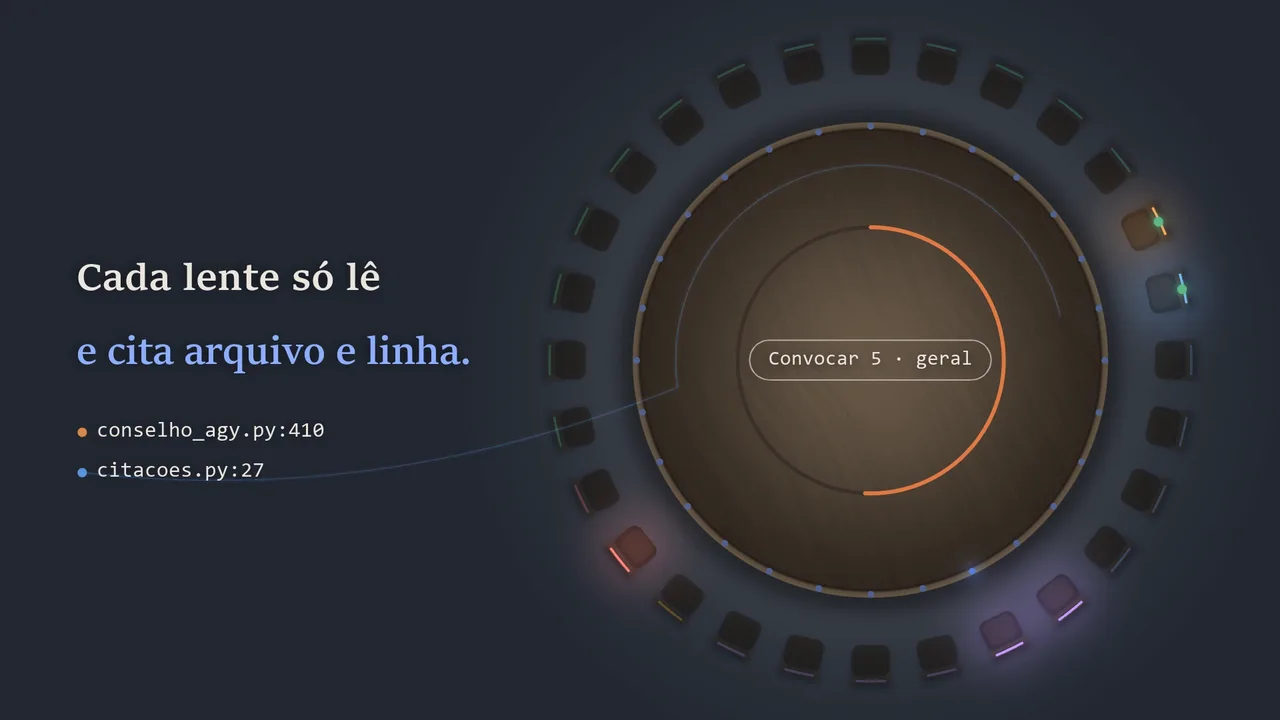
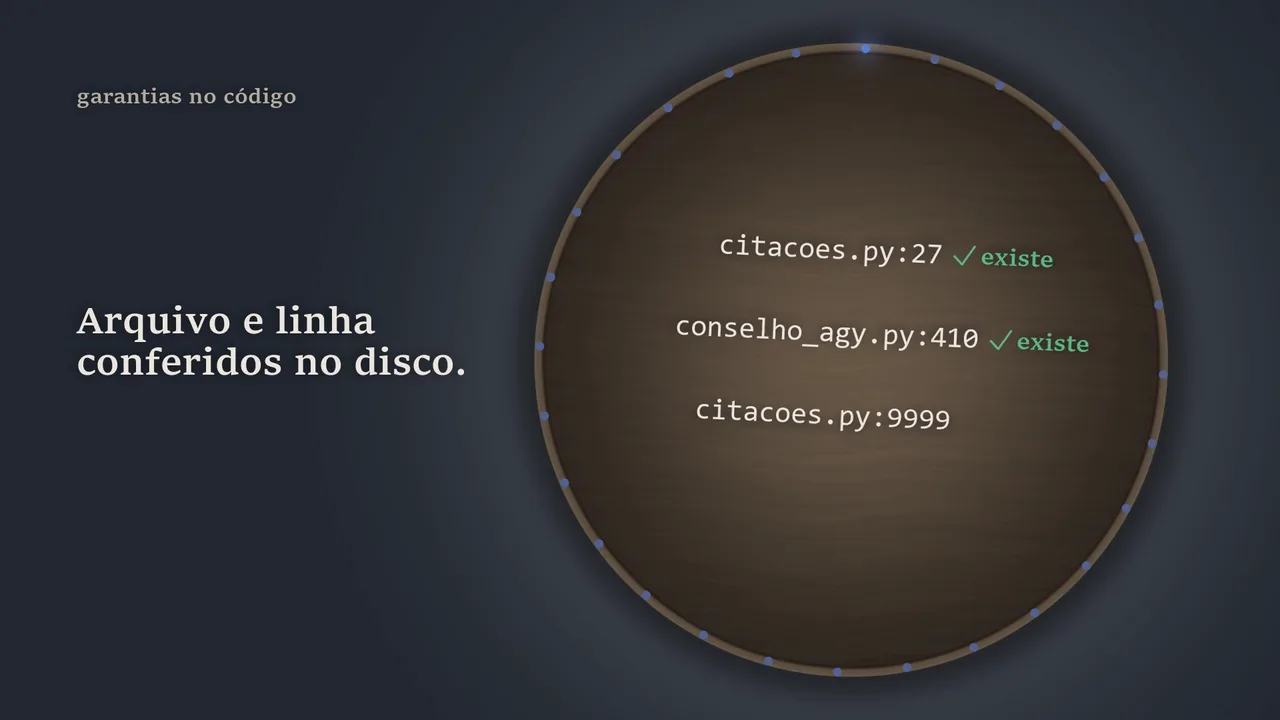
Each guide reads the project, unable to change anything, and points to where it saw each thing. A check confirms that the place pointed to exists; whatever does not exist is removed.
- Delivers the list, you decide
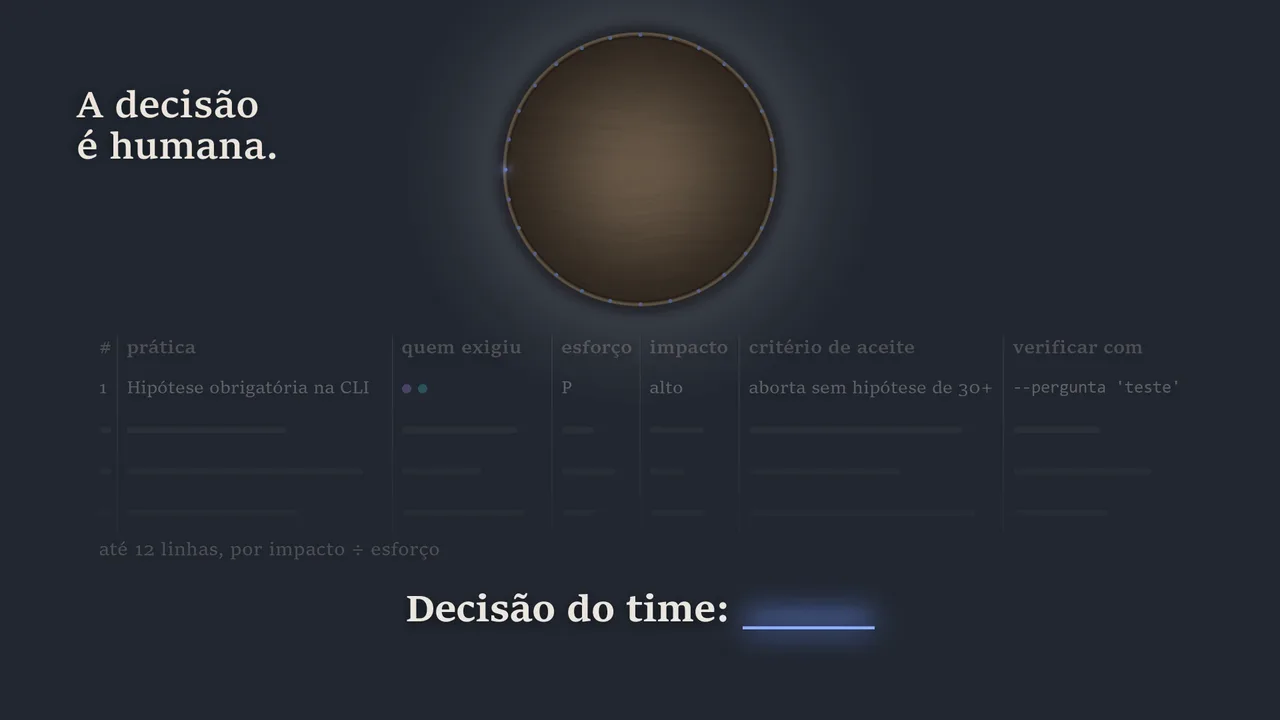
At the end, a short list of what to improve, each item with a way to check that it is done. The decision line is left blank for you.
On screen
Tap outside the image to close it.
Tap outside the image to close it.
Tap outside the image to close it.
Tap outside the image to close it.
Tap outside the image to close it.
What changes
- Before
- 8.45 M
- After
- 0.91 M
People with no time for a course learn, every week, from what the leading names in the field are teaching, and see that advice applied to their own project, with the exact place for each piece.
With all 28 at once, the round also pointed to 5 places that did not exist. With only the 5 for the topic, all 108 pointers were checked, and the cost is estimated before starting: if it goes over the limit, the round does not start without your go-ahead.
And the same approach can serve any field where it pays to learn from the references and review your own work through their eyes: the same engine already runs a table of 3D designers and a board for the thesis.
Technical explanation
Problem, improvement and result
- Problem
- Learning applied AI in depth without time for a course, and reviewing projects built with AI, which arrive without a trail: unjustified decisions, tests that never ran and citations nobody checked. Keeping up with what 28 references publish every week takes hours, and convening all of them for every review is expensive.
- Improvement
- 28 guides with citation, link and date, updated every Friday by a scheduled task that only accepts the reference's own sources, are turned by code into read-only reviewer subagents. Per topic, a panel of 3 to 5 lenses, with tokens estimated before spending and a refusal above 2 M; each file:line citation is checked on disk, and a moderator consolidates a backlog with acceptance criteria.
- Result
- On September 16, 2026, the round with all 28 lenses on the table itself cost 8.45 M tokens and invented 5 citations. On September 18, with the 5-lens panel: 914,000 tokens (about 89% less), 108 of 108 citations checked on disk (3 fixed on the second try) and an estimate of 1.36 M against the 2 M cap, computed before spending.
Evidence
108 of 108 citations checked on disk
In the September 18, 2026 round in which five lenses reviewed the table itself: each file:line citation is checked against the file, and 3 were fixed on the second try. The check proves the line exists, not that it supports the claim.
Measured.
58 test functions, with mutation testing
Counted in the public cut of the code on October 30, 2026; pytest with ruff and mypy. Mutation testing plants one defect at a time and checks whether the suite catches it.
Measured.
Question topic with 85% accuracy (ECE 0.08)
laya-tema, evaluated a single time on a locked final set of 108 questions; on the same test, the keyword rule got 50% right.
Measured.
The problem
Code written with AI arrives fast, but without a trail: undocumented decisions, tests that never ran and “facts” nobody checked. Reviewing everything by hand does not scale, and keeping up with what dozens of experts publish every week takes hours.
Mesa dos 28 is a systematic second pair of eyes for people who build with AI: lenses that cite what they read, a backlog with acceptance criteria, and the decision left to the person.
The guarantees in the code
Each lens is a subagent generated by code from a guide with a citation, a link and a date. What can go wrong is held in the code, not in the prompt:
file:linecitations checked against the disk, with one correction and then removal;- a token budget, with a refusal above the cap;
- the content of the reviewed project treated as data, against indirect prompt injection;
- secret masking, with an assertion at the end;
- mutation testing on the tests themselves.
The guides are updated every Friday by a scheduled task that fetches each expert’s published sources. The topic of each question is suggested by laya-tema.
On screen
Tap outside the image to close it.
Tap outside the image to close it.
Tap outside the image to close it.
Tap outside the image to close it.
Tap outside the image to close it.
How it works
Six steps, from the question to the backlog. The model reads and writes; the code checks.
- Bet
The person writes the hypothesis first; skipping is possible, but it is recorded.
Python - Topic
laya-tema suggests one of 9 topics; on its own it only applies at 0.8 confidence or more.
laya-tema85% accuracy - Context
Builds the context, runs the project's tests, masks secrets and estimates the cost.
Python2 M token cap - Lenses
Three to five read-only subagents write reviews citing file and line.
Antigravity CLI - Citations
The code checks each citation on disk; one that fails gets a correction and is then removed.
Python108 of 108 - Backlog
The moderator merges everything into up to 12 items, each with an acceptance criterion.
Python
The consolidated review comes out in Markdown, with a verification header written by the code, not by the model. Beside it, the header of the September 18, 2026 round, in which five lenses reviewed the table itself.
The table does not apply code, is not a merge gate and does not decide: the "Team decision" line stays blank, and the validator rejects the review if the model fills it in.
Testes do projeto: VERDE
Citações conferidas no disco: 108 de 108 existem
Tokens: 914 mil
Orçamento: estimativa 1.36 M · teto 2.00 M
Decisions
Instead of: All 28 lenses in every round.
Cost accepted: Fewer viewpoints per question; in exchange, about 0.9 M tokens against 8.45 M for the full table.
Instead of: Trusting the citations the model writes.
Cost accepted: The check proves the line exists, not that it supports the claim; the limit is written in the protocol.
Instead of: Pasting the project's content straight into the prompt.
Cost accepted: An envelope on every entry point and injection tests for each one.
Instead of: Reading the backlog with no prior expectation.
Cost accepted: One more step. On September 22, the table refuted the author's own hypothesis.
Instead of: Finding out what a round cost after paying for it.
Cost accepted: The estimate is conservative and may refuse a round that would fit; there is an explicit override.
How it was built
- Sep 11The guides
The most followed experts, with a course or channel; each guide with citation, link and date.
- Sep 12The table
The 28 guides become subagents, plus the 3D table and the engine on Antigravity.
- Sep 16The table reviews itself
The 28 lenses cost 8.45 M tokens and invent 5 citations; 27 of 28 ask for a lean panel.
- Sep 18The guarantees
Panel per topic, 2 M cap, citation checks, review validator, secret masking and a mandatory bet.
- Sep 22Mutation testing
The first run finds defects the green suite missed; 6 new tests are added.
- Oct 11The topic router
laya-tema is evaluated a single time on the locked set and starts suggesting the table's topic.
I built it with AI coding agents. Each failure of the table itself is recorded with a date, one line each, in the project's instruction file.
Limits
- The check guarantees that the cited file and line exist; checking whether the line supports the claim is the next step.
- The numbers come from rounds of the table on its own code; the next step is the pre-registered protocol, with 10 seeded defects and 3 decoys, which measures the table against a single reviewer.
Today and next
Today
The table runs on any project, through Claude Code, Codex or Antigravity, and the Journal updates the guides every Friday. The same engine already powers two more tables: the 3D Designers and the Thesis Board.
Next
- Run the pre-registered effectiveness protocol: 10 seeded defects and 3 decoys, the table against a single reviewer.
- Check whether the citation supports the claim, not just whether the line exists.
The guides synthesize the experts' public content; none of them has endorsed the project.
The images are frames from the project's ad, drawn for the video from the 3D table.